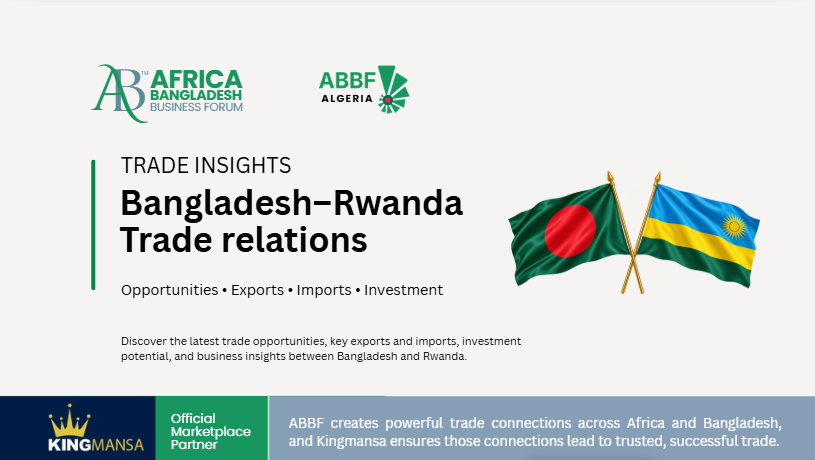
Bangladesh–Rwanda Trade Relations: Opportunities, Exports, Imports & Investment
Bangladesh Rwanda trade relations rest on something unusual: a wish list written by Rwanda itself. For over a decade, Rwandan officials have told Bangladeshi visitors what they want. The list reads like a Bangladeshi trade brochure: garments, ceramics, pharmaceuticals, and textile know-how. However, neither country has a resident ambassador in the other’s capital, and little trade has followed. This post looks at what Rwanda asked for, what it is building now, and where Bangladeshi businesses can fit.
Rwanda’s Wish List for Bangladesh
In 2012, a Bangladeshi delegation visited Rwanda. Rwandan officials used the visit to seek investment from Bangladeshi businesspeople. They named three products with huge demand in Rwanda: ready-made garments, ceramics, and pharmaceuticals. They also asked Bangladesh to share its experience in mechanised agriculture, food processing, textiles, garments, ceramics, and shipbuilding.
In 2015, Rwanda repeated the message. It hoped to strengthen ties through trade and investment, textile and jute industry development, and training in international peacekeeping. Rwanda’s high commissioner, who is based in New Delhi, has also urged Bangladeshi businesses to expand trade and investment in Central Africa. Bangladeshi investors promised to visit Rwanda and explore the options.
Peacekeepers, Planes, and Shared Ground
The two countries established diplomatic relations on 12 January 1984. A decade later, in 1994, Bangladesh sent roughly 900 peacekeeping troops to Rwanda during the genocide. They included soldiers and medical staff. Our overview of Bangladeshi peacekeepers and Africa ties tells more of that story. Both countries still rank among the biggest troop contributors to UN peacekeeping.
Connectivity followed. On 12 January 2023, the two sides signed a Bilateral Air Services Agreement at Bangladesh’s High Commission in New Delhi. The deal aims to improve links for people, cargo, and mail, and to support business and tourism. Both sides said they were still negotiating further agreements.
What Rwanda Is Building Now
Rwanda has set out to dress its own people. It banned second-hand clothing imports, and its government now backs the local garment industry. In 2025, Prime Minister Édouard Ngirente told Parliament that the aim is to clothe all Rwandans in locally made garments. At that time, local factories served only about 5% of the population, according to a report on his remarks. MPs also noted that local clothes cost more than imported ones.
The prime minister admitted another gap. Rwanda’s textile sector still relies on imported fabric. He promised a new project to raise domestic fabric production. The government is also encouraging private investment in textiles and garments. In addition, it wants a stable market for local apparel, including public school uniforms.
This policy matters for Bangladesh. It means Rwanda’s door is open to textile partners, but less so to bulk imports of finished clothing. Bangladesh’s real strength may lie upstream, in fabric, accessories, machinery, and factory know-how. Our look at the Africa textile industry and Bangladesh partnership explores that idea.
Rwanda’s Economy in 2026
Rwanda’s economy grew 9.4% in 2025. Forecasts for 2026 are lower, between about 6.5% and 7.5%, as oil prices rise and farm output softens. Agriculture supplies around 40% of exports, with coffee at 13% and tea at 12%, according to Coface.
The country also imports far more than it sells. The table below shows the second quarter of 2026, based on figures from Rwanda’s statistics office.
| Second quarter 2026 | Value (US$) |
|---|---|
| Domestic exports | 548.98 million |
| Re-exports | 179.59 million |
| Imports | 1,606.39 million |
| Trade deficit | 877.81 million |
Heavy imports mean buyers exist for foreign goods. However, high energy and transport costs squeeze importers. Rwanda also belongs to the East African Community, COMESA, and the AfCFTA. As a result, it can serve as a base for wider East and Central African sales.
A Competitor Is Already at the Table
Rwanda has not waited for Bangladesh. In 2026, Rwanda’s high commissioner to Pakistan invited Pakistani investors to Kigali. She called Rwanda a gateway to a 300-million-strong East African market. A Rwanda–Pakistan Investment Forum was set for 23–25 September 2026.
Rwanda told Pakistan it wants rice, pharmaceuticals, medical equipment, textiles, and sports goods. Pakistan and Bangladesh sell similar products. Bangladeshi exporters should therefore take note.
What Bangladesh Can Export to Rwanda
Rwanda’s own requests give this section a clear starting point:
- Fabrics and textile inputs — Rwanda still imports fabric for its garment factories, so this gap fits Bangladesh’s textile base.
- Ceramics — Rwanda named ceramics directly as a product in high demand. See our post on ceramics export from Bangladesh to Africa.
- Pharmaceuticals — Rwanda also named this sector. Bangladesh’s WHO-GMP certified industry competes well on price.
- Jute and jute goods — Rwanda showed interest in jute industry development in 2015. Learn more about Bangladesh’s role in global jute sustainability.
- Ready-made garments — Rwanda named this in 2012. Yet its policy now favours local production, so check duties and import rules first. See our coverage of RMG export opportunities across Africa.
Whether you’re a Bangladeshi exporter or a Rwandan buyer, connect with ABBF to find the right trade partner in this early-stage corridor.
What Rwanda Offers Bangladesh
- Coffee and tea — These are Rwanda’s top farm exports. They could suit Bangladeshi food and beverage importers.
- Minerals — Minerals lead Rwanda’s exports, but they flow mostly to China, the UAE, and neighbouring markets. They are not a near-term fit for Bangladesh.
Investment Opportunities in Rwanda
Rwanda’s textile plans open the clearest door. The government wants private investors to build fabric and garment capacity. A Bangladeshi spinning, weaving, or finishing company could partner with a local factory. That would answer Rwanda’s fabric gap directly.
Ceramics and food processing also appear on Rwanda’s wish list. Bangladeshi firms with experience in either field could explore joint ventures. Local press has also reported plans for a tannery park in Bugesera. Bangladesh’s leather sector could look at that project.
Rwanda’s envoy to Pakistan described her country as business-friendly, with investment protection and incentives. These are Rwanda’s own claims, so investors should verify them on the ground. Rwandan investors who want to look at Bangladesh can start with our invest in Bangladesh guide.
Ready to grow trade between Africa and Bangladesh? ABBF connects verified businesses on both sides, no cold outreach needed.
Answering Rwanda’s Wish List
Rwanda has been asking for over a decade. What has been missing is a channel for businesses to answer. That is where the Africa–Bangladesh Business Forum (ABBF) can help. Governments have named the products. Companies still need to meet.
Through Kingmansa, Bangladeshi exporters of fabric, ceramics, and pharma can reach Rwandan buyers directly. The membership program and B2B matchmaking service also help firms find partners before any official delegation travels. Because a South Asian competitor is already courting Kigali, a head start matters.
Join ABBF
Trade opportunities like these move fast, and the businesses that act early usually win the best deals. If you’re a Bangladeshi exporter looking to enter African markets, or an African buyer looking for verified Bangladeshi suppliers, joining ABBF gives you direct access to matchmaking, market insights, and a growing network on both sides of the trade.
What’s Actually Slowing This Down
Several barriers explain why trade is thin. First, neither country has a resident ambassador. Rwanda’s high commissioner works from New Delhi, so routine trade support is limited. Second, we found no reliable bilateral trade figures, which makes demand hard to measure.
Third, Rwanda’s push for local garments limits the market for finished clothing. Finally, Rwanda is landlocked, so cargo normally arrives through ports in neighbouring countries. Our posts on Bangladesh–Tanzania trade relations and Bangladesh–Kenya trade relations cover those routes. Read more about the network of Bangladeshi embassies across Africa supporting market entry.
Getting Started with Bangladesh–Rwanda Trade
Start with the products Rwanda has already named. Lead with fabric, ceramics, and pharma rather than finished garments. Explore our guides on how to find buyers in Africa and how to source products from Bangladesh. Also check our visa guide for Africa before planning a trip. For a neighbouring market with a similar story, see our Bangladesh–Uganda trade relations post.
Frequently Asked Questions
What has Rwanda asked Bangladesh for?
Rwanda has named ready-made garments, ceramics, and pharmaceuticals as products in high demand. It has also asked for Bangladesh’s experience in textiles, food processing, mechanised agriculture, and shipbuilding.
Does Bangladesh have an embassy in Rwanda?
No. Neither country has a resident ambassador in the other’s capital. Rwanda’s high commissioner works from New Delhi.
When did Bangladesh and Rwanda establish diplomatic relations?
They established relations on 12 January 1984. Bangladesh also sent roughly 900 peacekeeping troops to Rwanda in 1994.
Can Bangladesh export garments to Rwanda?
Rwanda named garments as a demand area, but it now promotes locally made clothing. Exporters should check duties and import rules before shipping.
What is Rwanda’s trade position?
Rwanda imports far more than it exports. In the second quarter of 2026, imports reached about $1.6 billion against domestic exports of about $549 million.
How can a Bangladeshi business start exploring the Rwandan market?
Structured B2B matchmaking offers a practical start. Platforms like Kingmansa and ABBF’s membership network connect verified buyers and sellers directly.
The Bottom Line
Bangladesh–Rwanda trade relations are a case of a request still waiting for an answer. Rwanda has named its needs for more than a decade, and Bangladesh already makes what it asked for. A South Asian rival is now courting Kigali. The smartest entry is not bulk clothing but fabric, ceramics, pharma, and factory partnerships. Businesses that move early can turn an old wish list into real orders.
Whether you’re a Bangladeshi manufacturer or a Rwandan importer, ABBF is built to connect you with the right partner on the other side.
You May Also Like