

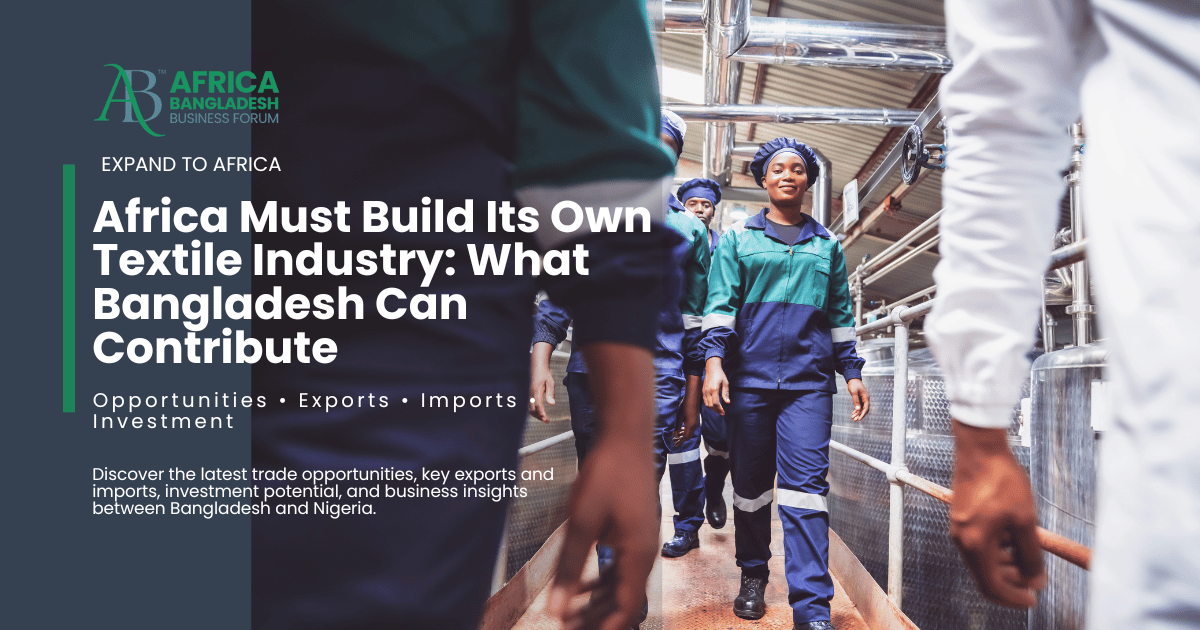
Africa Must Build Its Own Textile Industry: What Bangladesh Can Contribute
Africa’s textile industry has an opportunity that goes far beyond importing finished garments.
Across the continent, countries are looking for ways to industrialize, create employment, strengthen local manufacturing and capture more value from their own resources. Textiles and apparel can play an important role in that transformation.
The long-term opportunity is therefore not simply to replace one foreign supplier with another.
It is to build African-owned textile and apparel ecosystems capable of producing, processing, designing, branding and eventually exporting at scale.
Bangladesh can be an important partner in that journey.
Not because Bangladesh should own Africa’s textile industry, but because decades of experience in building one of the world’s major garment manufacturing ecosystems can provide knowledge, technology, investment partnerships and practical lessons that African businesses can adapt to their own markets.
From Importing Products to Building Industries
Many African economies continue to import substantial volumes of textiles, fabrics, garments, footwear and other consumer products.
Imports will remain an important part of international trade. No country produces everything it consumes.
But there is a major difference between participating in global trade and becoming structurally dependent on imported finished products.
Africa has an opportunity to move progressively up the textile value chain:
Raw materials → fibre processing → spinning → weaving and knitting → dyeing and finishing → garment manufacturing → design → branding → distribution → exports
The more stages that take place within African economies, the more economic value can potentially remain within those economies.
That can translate into factories, technical skills, local suppliers, logistics businesses, designers, brands, retailers and jobs.
This is particularly important as African countries seek to expand manufacturing and develop stronger regional value chains.
Why Textiles Matter for African Industrialization
Textile and clothing manufacturing has historically played an important role in the industrial development of several economies.
The sector has characteristics that make it particularly relevant for emerging manufacturing markets.
It can create employment at scale, develop industrial skills, stimulate supporting industries and establish export-oriented manufacturing capabilities.
Research from UN Trade and Development (UNCTAD) has highlighted the importance of textiles and clothing for employment, value-chain development and industrialization in developing economies.
A functioning textile ecosystem also creates demand for other sectors, including:
- Packaging
- Logistics
- Machinery
- Chemicals and dyes
- Garment accessories
- Warehousing
- Technology
- Financial services
- Design and marketing
The objective should therefore extend beyond opening garment factories.
Africa needs complete textile ecosystems.
Africa Already Has Part of the Supply Chain
One of the most interesting aspects of Africa-Bangladesh textile trade is that the relationship already works in both directions.
African countries are becoming increasingly important suppliers of cotton to Bangladesh’s textile industry.
As ABBF examined in its report on Africa’s growing role as a cotton supplier to Bangladesh, African suppliers accounted for around 41% of Bangladesh’s cotton imports during the 2024–25 marketing year.
Countries such as Benin, Cameroon, Burkina Faso and Mali are already connected to Bangladesh through the cotton supply chain.
The opportunity is particularly visible in West Africa. ABBF has also examined the potential for deeper Burkina Faso-Bangladesh cotton trade, including opportunities to create more direct relationships between cotton producers and Bangladesh’s textile industry.
This creates an important strategic question:
How can African economies capture more value before their raw materials leave the continent?
Instead of exporting mainly raw cotton, greater investment could gradually support:
Cotton → yarn → fabric → garments → African brands
This does not mean abandoning cotton exports to Bangladesh or other markets.
It means creating the capacity to process a larger share locally while continuing to participate in international trade.
Moving Up the Textile Value Chain
The opportunity becomes clearer when we look at where value is created.
Raw cotton represents only the beginning of the textile value chain.
Once cotton is spun into yarn, woven or knitted into fabric, dyed, finished, cut, sewn, branded and distributed, significantly more economic activity has taken place.
UNCTAD’s research on global natural and man-made fibre trade demonstrates how fibres, yarn and fabrics form interconnected stages of the international textile industry.
For African economies, the strategic opportunity is therefore not simply increasing cotton production.
It is increasing value addition.
A country that exports cotton but imports finished clothing participates in both ends of the textile economy while potentially missing many of the industrial activities between them.
Developing those intermediate capabilities can create new businesses and employment opportunities.
The Bangladesh Experience Offers Useful Lessons
Bangladesh provides an interesting case study.
The country did not become a major garment manufacturing economy overnight.
Its apparel industry developed over decades through entrepreneurship, workforce development, international partnerships, factory investment, buyer relationships and increasing manufacturing specialization.
According to the Bangladesh Garment Manufacturers and Exporters Association (BGMEA), the ready-made garment sector has become the country’s largest export-earning industry.
Bangladesh has developed significant capabilities across areas such as:
- Ready-made garment manufacturing
- Knitwear
- Woven garments
- Denim
- Textile engineering
- Spinning and knitting
- Washing, dyeing and finishing
- Garment accessories
- Quality control
- Factory management
- Export documentation
- International sourcing
- Large-scale production
African businesses already interested in Bangladesh’s manufacturing capabilities can also read ABBF’s guide to importing garments from Bangladesh.
But the bigger opportunity is not simply importing more garments.
It is asking:
What parts of Bangladesh’s manufacturing knowledge can be transferred, adapted and developed within Africa?
African countries do not need to reproduce the Bangladeshi model exactly.
They can learn from it.
Partnership, Not Dependency
This distinction is important.
Africa-Bangladesh textile cooperation should not be based solely on Bangladesh selling finished products to Africa.
There is a much larger opportunity.
Bangladeshi manufacturers, engineers, textile professionals and entrepreneurs can partner with African companies to help establish production capacity inside African markets.
Instead of only:
Bangladesh produces → Africa imports
the relationship can increasingly become:
Africa + Bangladesh invest → produce → distribute → export together.
This approach can create stronger and more balanced long-term economic relationships.
1. Joint Manufacturing Ventures
African and Bangladeshi businesses can establish jointly owned textile and garment factories.
African partners can contribute market knowledge, local networks, investment and regional distribution capabilities.
Bangladeshi partners can contribute manufacturing expertise, technical knowledge, production systems and international sourcing experience.
Such partnerships could begin with relatively accessible manufacturing activities before gradually expanding into more complex textile processing.
2. Technical Knowledge Transfer
Factories require more than machinery.
They require people who understand production planning, quality control, industrial engineering, merchandising, compliance and supply-chain management.
Bangladesh has accumulated decades of practical experience in these areas.
Structured technical cooperation between African and Bangladeshi institutions and companies could help shorten the learning curve for emerging African manufacturers.
3. Machinery and Factory Setup
Establishing an efficient textile or garment factory requires decisions about machinery, factory layout, workflow, productivity, energy requirements and production systems.
Bangladeshi textile professionals have extensive experience operating manufacturing plants serving demanding international buyers.
That expertise can support African investors in factory planning, machinery selection, production-line design and operational management.
4. Skills Development
Vocational and technical training will be critical.
Training partnerships could focus on:
- Sewing-machine operation
- Textile engineering
- Industrial engineering
- Quality assurance
- Merchandising
- Factory supervision
- Production planning
- Compliance
- Supply-chain management
The objective should be to develop local expertise so that African professionals progressively manage and expand the industry themselves.
5. African Brands and Design
Manufacturing is only part of the opportunity.
Africa should also capture value through African-owned brands.
African designers already influence fashion globally. Combining this creativity with scalable local manufacturing could produce brands capable of competing domestically, regionally and internationally.
The goal should not simply be:
Made in Africa.
It should increasingly become:
Designed in Africa. Made in Africa. Owned in Africa. Sold globally.
That is where manufacturing becomes industrial ownership.
AfCFTA Changes the Scale of the Opportunity
The African Continental Free Trade Area (AfCFTA) adds another important dimension to Africa’s textile opportunity.
A textile factory should not necessarily be designed around the consumer market of one country.
Greater African economic integration makes it possible to think at a much larger scale.
A manufacturer established in Ghana, Nigeria, Kenya, Ethiopia or another suitable production location can increasingly think about serving regional markets rather than only domestic customers.
This changes the economics of industrial investment.
Instead of asking:
“Is this country’s domestic market large enough for a factory?”
Investors can increasingly ask:
“Can this factory become part of a regional African supply chain?”
That is a much more powerful proposition.
African Ownership Does Not Mean Economic Isolation
Industrial ownership does not mean Africa must do everything alone.
Modern manufacturing depends on international partnerships.
Machinery may come from one country.
Technical experts may come from another.
Investment may involve partners from several markets.
Raw materials may cross borders.
Technology, logistics and financing may involve international companies.
Africa can welcome expertise from Bangladesh, China, India, Türkiye, Europe and elsewhere while developing its own industrial capabilities.
The principle should be simple:
Global knowledge. African capacity. African ownership.
International partnership and African ownership are not contradictory.
In fact, well-structured partnerships can accelerate the development of locally owned industries.
What Bangladesh Gains
This model also creates significant opportunities for Bangladesh.
Bangladeshi companies face increasing pressure to diversify markets, establish international partnerships and identify new areas for long-term growth.
Africa represents much more than a destination for finished products.
For companies looking at the existing trade opportunity, ABBF already provides resources for Bangladeshi garment manufacturers seeking African importers.
But the next generation of opportunities could go considerably further.
Bangladeshi businesses can participate in:
- Joint ventures
- Textile machinery and technical services
- Factory management
- Industrial consulting
- Skills development and training
- Fabric and accessories supply
- Technology
- Logistics
- Sourcing
- Regional distribution
- Manufacturing investment
The commercial relationship therefore becomes more sophisticated than a traditional exporter-importer relationship.
Bangladesh can become a manufacturing and knowledge partner in Africa’s industrial development.
What African Businesses Gain
African entrepreneurs and investors gain access to decades of practical manufacturing experience.
Instead of developing every capability from the beginning, partnerships can shorten the learning curve.
This is particularly valuable for SMEs and emerging manufacturers that need access to reliable technology partners, production specialists and international supply networks.
Over time, the objective should be to localize more capabilities.
Local workers become supervisors.
Supervisors become managers.
Local suppliers replace imported inputs where commercially viable.
African designers develop African brands.
African factories begin supplying neighboring countries.
Eventually, some become global exporters.
That is how an ecosystem develops.
A New Vision for Africa-Bangladesh Textile Cooperation
Africa-Bangladesh trade should continue growing.
Bangladeshi garments can serve African buyers where they are competitive.
African cotton can continue supplying Bangladeshi textile mills.
But the relationship should not stop there.
The next stage can involve:
African resources + African investment + Bangladeshi manufacturing expertise + African workforce + regional markets = stronger African textile industries.
This creates a relationship based not only on buying and selling, but also on co-investment, skills transfer, industrial development and shared growth.
The existing cotton relationship demonstrates that the foundations of this partnership already exist.
The next challenge is moving further up the value chain.
ABBF’s Role in Building These Partnerships
The Africa Bangladesh Business Forum (ABBF) is a pan-African trade and business facilitation platform working to strengthen commercial, investment and institutional partnerships between Africa and Bangladesh.
For the textile and apparel sector, this means helping create connections between:
- African manufacturers and Bangladeshi technical partners
- African investors and Bangladeshi textile companies
- African importers and manufacturers
- Textile associations and industry bodies
- Entrepreneurs seeking joint ventures
- Businesses looking for market-entry partners
- Cotton producers and textile companies
- Investors seeking manufacturing opportunities
Through B2B matchmaking, trade missions, business summits, market intelligence and institutional engagement, ABBF aims to move Africa-Bangladesh commercial relationships beyond individual transactions toward long-term partnerships.
Join the Africa Bangladesh Business Forum
Are you an African entrepreneur looking for manufacturing partners?
Are you a Bangladeshi textile or garment company exploring opportunities in Africa?
Or are you an investor interested in developing cross-border industrial projects?
Become a Member of the Africa Bangladesh Business Forum and connect with businesses, investors, buyers, suppliers and institutions working across Africa and Bangladesh.
ABBF members can access business matchmaking, trade and investment opportunities, business delegations, webinars and other cross-border business support.
Take the Partnership Online with Kingmansa
Physical trade relationships increasingly need digital infrastructure.
Kingmansa is a global B2B marketplace designed to connect businesses with buyers, suppliers and cross-border trade opportunities.
African businesses can use the platform to discover suppliers and products, while manufacturers and exporters can increase their visibility among international buyers.
Explore Kingmansa and discover B2B opportunities.
Conclusion
The future of Africa’s textile industry should not be defined by choosing between imports and isolation.
There is another path:
Partnership with ownership.
Africa can work with experienced manufacturing economies such as Bangladesh while building factories, skills, brands, supply chains and intellectual capital within the continent.
Bangladesh has valuable manufacturing experience.
Africa has resources, entrepreneurs, workers, creativity and a vast consumer market.
Bringing those strengths together could create something much more valuable than another trade corridor.
It could help build an industrial ecosystem.
The strongest measure of success will ultimately not be how much Africa imports.
It will be how much value Africa creates.
You May Also Like