

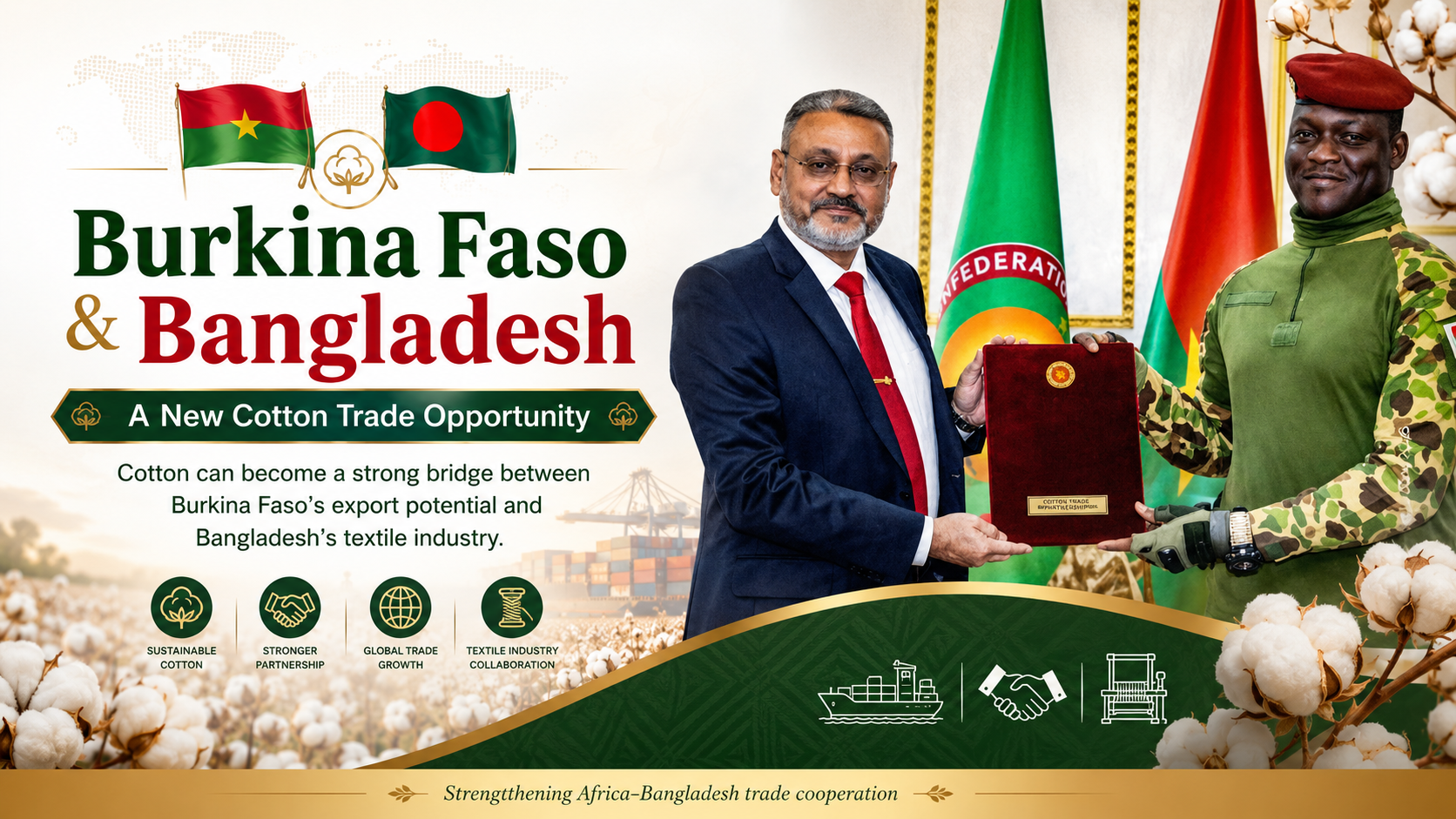
An Unexpected Partnership: How Cotton Can Link Burkina Faso and Bangladesh
Bangladesh and Burkina Faso may seem geographically distant, but their economies have a powerful point of connection: cotton.
For Burkina Faso, cotton is one of the country’s most important agricultural export products and a major source of rural livelihood. For Bangladesh, cotton is the foundation of its textile and ready-made garment industry—one of the strongest manufacturing sectors in the world. A direct cotton trade partnership between the two countries could therefore create a practical and mutually beneficial bridge between West Africa and South Asia.
Burkina Faso: A Cotton Economy with Global Relevance
Cotton is often called “white gold” in Burkina Faso because of its role in rural income, employment, and export earnings. According to the Islamic Development Bank, Burkina Faso’s cotton sector supports millions of rural livelihoods, while around 15–20% of the country’s workforce relies on cotton-related activity. The sector is also a major contributor to GDP and a key source of foreign currency.
Recent trade data also shows Burkina Faso’s continued importance in the global cotton market. In 2024, Burkina Faso exported around US$353–356 million worth of cotton, making raw cotton one of the country’s top export products after gold.
The Food and Agriculture Organization also notes that cotton plays an important role in Burkina Faso’s economy, accounting for about 4% of GDP and 14% of export earnings. This makes cotton not only an agricultural commodity but also a strategic sector for trade, employment, and economic stability.
Bangladesh: A Textile Powerhouse with Huge Cotton Demand
Bangladesh is one of the world’s leading garment manufacturing hubs. The country’s export-oriented ready-made garment industry employs millions of workers and depends heavily on imported cotton because domestic cotton production is very limited.
According to USDA data reported by The Financial Express, Bangladesh was projected to import around 8 million bales of cotton in FY 2024–25 and become the world’s largest cotton importer, overtaking China. The report also noted that West Africa was Bangladesh’s top cotton supplier in the previous fiscal year, accounting for 35% of total cotton imports.
This shows a clear opportunity: Bangladesh already sources cotton from West Africa, and Burkina Faso is one of the region’s important cotton-producing economies. A direct trade arrangement could make the supply chain more efficient, transparent, and cost-effective.
A New Diplomatic and Trade Opportunity
The opportunity became more visible after Bangladesh’s non-resident Ambassador to Burkina Faso, Major General Md. Habib Ullah, presented his credentials to President Captain Ibrahim Traoré on 26 June 2026. During the meeting, Bangladesh expressed interest in strengthening bilateral cooperation, including the possibility of direct cotton trade with Burkina Faso.
For Bangladesh, direct sourcing from Burkina Faso could help secure raw materials for the textile and garment industry. For Burkina Faso, it could open a stable market in one of the world’s biggest cotton-consuming economies.

Why Direct Cotton Trade Matters
A direct cotton trade partnership can reduce dependency on multiple intermediaries, improve price transparency, and create stronger business confidence between exporters and buyers. It can also support long-term supply agreements, quality control, logistics coordination, and smoother payment systems.
For Burkina Faso, the benefit is market diversification. Instead of depending mainly on traditional buyers, the country can expand its cotton exports to fast-growing Asian manufacturing markets. For Bangladesh, the benefit is supply diversification. With rising global uncertainty, raw material security has become a strategic priority for the garment sector.
This is especially important as Bangladesh’s garment industry faces pressure from changing global trade conditions. Analysts have warned that higher U.S. tariffs on Bangladeshi goods could create major challenges for the RMG sector and increase the need for stronger cost management and supply chain resilience.
Beyond Cotton: A Wider Trade Relationship
Cotton can be the starting point, but the partnership does not need to stop there. Bangladesh has strong export potential in ready-made garments, pharmaceuticals, leather goods, jute products, ceramics, light engineering, and processed food. Burkina Faso, on the other hand, offers opportunities in cotton, agriculture, mining-related supply chains, and regional trade access in West Africa.
A cotton partnership could therefore become the foundation for a wider Bangladesh–Burkina Faso trade relationship.
The Role of Business Platforms
To turn this opportunity into real business, both countries need stronger private-sector engagement. Exporters, importers, textile mills, chambers of commerce, trade bodies, logistics companies, and financial service providers must work together to build a reliable trade channel.
This is where platforms such as the Africa Bangladesh Business Forum (ABBF) can play an important role. ABBF works to connect Bangladeshi exporters, manufacturers, and business organizations with African buyers, importers, distributors, chambers of commerce, and relevant business communities through networking, B2B matchmaking, trade promotion, and market access support.
By facilitating direct business connections, verified networking, and trade dialogue, ABBF can help transform diplomatic interest into practical commercial outcomes.
Conclusion
The proposed cotton partnership between Burkina Faso and Bangladesh is more than a commodity trade opportunity. It is a strategic bridge between an African cotton-producing economy and a South Asian textile manufacturing powerhouse.
For Burkina Faso, it can create access to a stable and growing market. For Bangladesh, it can strengthen raw material security and support the competitiveness of its garment industry.
In a changing global trade environment, such South–South cooperation is not only timely—it is necessary. Cotton could become the thread that connects Burkina Faso and Bangladesh in a new era of trade, partnership, and shared economic growth.
You May Also Like