


Jute Products Export to Nigeria: Opportunities for Bangladesh
Jute Products Export to Nigeria represents a promising market diversification opportunity for Bangladeshi manufacturers seeking to expand beyond their traditional export destinations. Nigeria’s large agricultural economy, growing non-oil export activities, demand for durable packaging, and increasing interest in environmentally responsible materials create several practical opportunities for jute sacks, shopping bags, yarn, fabric and other value-added jute products.
Bangladesh already has an established position in Nigeria’s jute sack market. However, success requires more than simply offering standard products. Exporters must understand Nigerian industries, buyer expectations, product specifications, pricing, logistics and local business practices.
This guide explains the market opportunity and provides practical recommendations for Bangladeshi jute manufacturers interested in entering or expanding within Nigeria.
Understanding the Nigeria Jute Market
Nigeria is one of Africa’s most commercially important economies and has a large domestic market supported by agriculture, food processing, wholesale trading, construction and consumer retail.
Jute products are particularly relevant to Nigeria because they can serve both industrial and consumer markets. Agricultural exporters need strong sacks for storing and transporting commodities, while retailers and environmentally conscious businesses increasingly require reusable packaging alternatives.
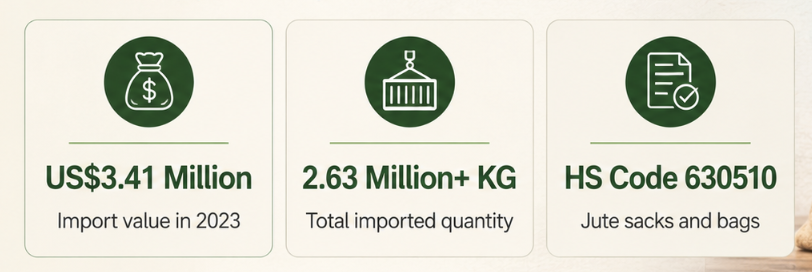
Trade data confirms that Nigeria already imports a meaningful quantity of jute packaging. In 2023, the country imported approximately US$3.41 million worth of jute sacks and bags, classified under HS code 630510, with a total reported quantity of more than 2.63 million kilograms.
Bangladesh supplied approximately US$1.75 million and over 1.28 million kilograms of those imports, making it one of Nigeria’s most important suppliers in this product category.
These figures demonstrate that the market is not only theoretical. Nigerian businesses are already purchasing jute sacks from international suppliers, and Bangladesh has an existing foothold that its manufacturers can develop further.
Why Jute Products Export to Nigeria Has Potential
Several economic and environmental factors support the potential for greater trade between Bangladeshi jute manufacturers and Nigerian buyers.
Strong agricultural packaging requirements
Nigeria produces and exports a wide range of agricultural commodities, including cocoa, sesame seeds and cashew nuts. The Nigerian Export Promotion Council identifies these products among the country’s important non-oil export sectors.
Agricultural products must be collected, stored, transported and shipped safely. This creates demand for reliable packaging materials that can withstand handling throughout the supply chain.
Jute sacks are suitable for many dry agricultural commodities because they are:
- Strong and reusable
- Breathable
- Suitable for bulk handling
- Available in different weights and sizes
- Printable with company or product information
- Made from a natural fibre
Bangladeshi exporters can target Nigerian processors, commodity traders, agricultural cooperatives, warehouse operators and export companies that require regular supplies of packaging materials.
Expanding non-oil export activities
Nigeria has been working to diversify its economy and increase non-oil exports. According to the Nigerian Export Promotion Council, cocoa, sesame, cashew and other agricultural products remain important contributors to the country’s export economy.
As the volume and quality of agricultural exports increase, demand may also grow for packaging that meets buyer specifications in destination markets.
Bangladeshi manufacturers can position jute sacks as an export-grade packaging solution for Nigerian companies selling agricultural goods to Europe, Asia, the Middle East and other African countries.
Demand for sustainable packaging in Nigeria
Environmental concerns are gradually changing the packaging conversation in Nigeria. Lagos State introduced restrictions on several single-use plastic items from July 2025, although implementation and the availability of affordable alternatives remain challenging.
Jute cannot replace every type of plastic packaging. However, reusable jute shopping bags, promotional bags and natural-fibre packaging can serve as practical alternatives in selected applications.
This creates potential opportunities among:
- Supermarkets and retail chains
- Corporate organisations
- Hotels and hospitality businesses
- Event organisers
- Fashion and lifestyle brands
- Food and agricultural companies
- Environmental campaigns
- Promotional merchandise suppliers
Exporters should avoid marketing jute as a universal replacement for plastic. A stronger strategy is to identify specific uses where durability, reusability and natural appearance provide genuine commercial value.
Bangladesh’s manufacturing strength
Bangladesh has an internationally recognised jute industry with experience producing traditional and diversified jute products.
Manufacturers can supply:
- Standard jute sacks
- Hessian bags
- Food-grade or export-grade agricultural bags
- Jute yarn and twine
- Hessian cloth
- Reusable shopping bags
- Promotional bags
- Gift bags
- Jute-based home décor
- Jute geotextiles
- Nursery and agricultural products
This broad production capacity allows Bangladeshi jute exporters to serve both Nigeria’s industrial packaging market and its developing consumer market.
Ready to Enter Nigeria’s Jute Market?
Africa Bangladesh Business Forum helps Bangladeshi jute manufacturers connect with Nigerian buyers, importers and distributors through B2B matchmaking and the upcoming Africa Bangladesh Trade Show & Business Summit, taking place on 6–7 October 2026 in Abuja, Nigeria.

Jute Bags for Agricultural Packaging
The most immediate opportunity is likely to remain jute bags for agricultural packaging.
Nigeria is a producer and exporter of cocoa, sesame, cashew, ginger and other agricultural commodities. The Nigerian Export Promotion Council reports that sesame exports have ranged between approximately 140,000 and 180,000 tonnes annually in recent years, demonstrating the scale of packaging required across the sector.
Different commodities may require different bag specifications. Before sending a quotation, manufacturers should ask buyers about:
- Required bag dimensions
- Fabric weight or GSM
- Carrying capacity
- Stitching style
- Food-contact requirements
- Inner lining requirements
- Moisture resistance
- Printing colours
- Logo placement
- Bale packing method
- Required quantity
- Delivery destination
A generic price list is rarely enough for serious B2B buyers. Suppliers that collect detailed specifications before quoting are more likely to avoid quality disputes and pricing errors.
Value-Added Products for the Nigerian Market
Traditional sacks may generate volume, but diversified jute products can offer higher margins and stronger brand positioning.
Reusable jute shopping bags
Retailers, supermarkets, exhibitions and corporate organisations can use branded jute bags as reusable shopping or promotional products.
Manufacturers can offer:
- Laminated jute bags
- Cotton-handle jute bags
- Coloured jute fabric
- Custom logo printing
- Small minimum order options
- Different handle lengths
- Zipper or button closures
Nigerian buyers may value attractive designs and practical durability more than the environmental message alone. Product marketing should therefore emphasise usability, branding potential and long-term value.
Promotional and corporate gift bags
Nigeria has a large corporate, banking, telecom, hospitality and event sector. Businesses regularly require branded merchandise for conferences, product launches, employee gifts and customer campaigns.
Bangladeshi manufacturers can develop product catalogues specifically for:
- Conferences
- Trade exhibitions
- Government programmes
- Corporate gift campaigns
- Hotels and resorts
- Universities
- Non-governmental organisations
High-quality samples and professional product photography will be essential when targeting this segment.
Jute yarn, twine and fabric
Some Nigerian importers may prefer semi-finished materials rather than finished bags. Jute yarn, twine and hessian cloth can be supplied to packaging companies, handicraft businesses, decorators and local manufacturers.
This B2B model can create recurring orders if exporters find reliable industrial users or distributors.
Jute geotextiles and agricultural applications
Jute geotextiles can be used for erosion control, landscaping, soil protection and selected infrastructure projects. However, this segment requires technical knowledge, proper documentation and cooperation with project contractors or engineering organisations.
Bangladeshi manufacturers entering this category should prepare:
- Technical data sheets
- Product performance information
- Installation guidance
- Test reports
- Product samples
- Relevant certifications
This should be treated as a specialised business development opportunity rather than a simple commodity sale.
How Bangladeshi Jute Exporters Can Enter Nigeria
Entering Nigeria successfully requires a structured market development approach.
1. Select the right product segment
Do not attempt to sell every type of jute product at the beginning.
A manufacturer should initially select one or two priority segments, such as:
- Cocoa and agricultural sacks
- Sesame or cashew packaging
- Reusable shopping bags
- Corporate promotional bags
- Jute yarn and fabric
A focused approach makes it easier to identify buyers, prepare samples and communicate a clear value proposition.
2. Identify serious Nigeria jute product buyers
Potential buyers may include:
- Agricultural exporters
- Commodity processors
- Packaging distributors
- Wholesale importers
- Supermarket chains
- Promotional product companies
- Corporate gift suppliers
- Hotels and event businesses
- Construction and landscaping companies
The Nigerian Export Promotion Council maintains information on Nigerian exporters and key non-oil sectors, which can help manufacturers understand potential customer categories.
Business forums, trade exhibitions, chambers of commerce, industry associations and verified B2B matchmaking programmes can also help exporters reach decision-makers.
3. Prepare samples for Nigerian buyers
Jute products are highly specification-dependent. Buyers often want to examine fabric quality, stitching, printing and carrying capacity before placing a commercial order.
A useful sample package should include:
- Two or three product variations
- Specification sheets
- Available colours and printing options
- Minimum order quantity
- Production lead time
- Packing details
- Indicative price range
- Company profile
- Export certificates and factory information
Samples should reflect the exact quality that will be supplied in bulk.
4. Offer clear export quotations
A professional quotation should mention:
- Product description
- HS code
- Size and weight
- Material composition
- Printing details
- Order quantity
- Unit price
- Incoterm
- Port of loading
- Delivery schedule
- Payment terms
- Quotation validity
- Inspection conditions
Exporters should avoid providing an unrealistically low initial price that cannot be maintained after confirming specifications.
5. Verify Nigerian import requirements
Importers and exporters should confirm product classifications, duties and documentation before shipment.
The Nigeria Customs Service provides an official Common External Tariff lookup portal where traders can review HS classifications and tariff information.
Requirements may differ depending on whether the shipment contains standard sacks, coated bags, printed shopping bags, fabric, yarn or other value-added products. A Nigerian customs broker or experienced importer should verify the final classification.
6. Build a local distribution relationship
A reliable Nigerian distributor can help with:
- Import clearance
- Warehousing
- Local delivery
- Buyer communication
- Tender monitoring
- Payment collection
- After-sales support
- Repeat-order development
However, manufacturers should conduct due diligence before granting exclusivity. A trial period with measurable sales targets is safer than immediately appointing a nationwide exclusive agent.
7. Connect with Nigerian Buyers Through ABBF
Entering a new market is easier with trusted local connections. The Africa Bangladesh Business Forum (ABBF) helps Bangladeshi jute exporters connect with Nigerian buyers, importers, distributors and business leaders through B2B matchmaking, trade networking and market-entry support.
Exporters can also showcase their products at the upcoming Africa Bangladesh Trade Show & Business Summit, taking place on 6–7 October 2026 in Abuja, Nigeria. The event will provide opportunities to meet potential buyers, present product samples and explore long-term business partnerships in the Nigerian market.
Ready to Enter Nigeria’s Jute Market?
Africa Bangladesh Business Forum (ABBF) helps Bangladeshi jute manufacturers connect with Nigerian buyers, importers and distributors through B2B matchmaking and the upcoming Africa Bangladesh Trade Show & Business Summit, taking place on 6–7 October 2026 in Abuja, Nigeria.
8. Use Kingmansa to Reach African Buyers
Bangladeshi jute exporters can also use Kingmansa, the official B2B marketplace of ABBF, to showcase their products and connect with buyers, importers and distributors across Nigeria and other African markets.
Through Kingmansa, exporters can present product catalogues, receive business enquiries, explore buyer requirements and build direct trade connections.
Common Challenges and Mistakes
Competing only on price
Low prices may attract enquiries but do not guarantee sustainable business. Nigerian buyers also consider consistency, shipment reliability, printing quality, bag strength and payment flexibility.
Manufacturers should compete on total value rather than price alone.
Ignoring product specifications
A jute sack designed for one commodity may not be suitable for another. Incorrect weight, dimensions, weave density or stitching can cause product loss and buyer complaints.
Every order should be supported by an approved specification sheet and physical sample.
Sending quotations without understanding logistics
Freight, port charges, customs expenses and inland transportation can significantly affect the buyer’s final cost.
Exporters should clearly state whether the quotation is FOB, CFR, CIF or another agreed Incoterm.
Working with unverified intermediaries
International trade enquiries may come from agents who have no direct connection with the final buyer.
Before offering credit or exclusivity, exporters should verify:
- Company registration
- Business address
- Import history
- Website and corporate email
- Decision-maker identity
- Bank details
- References
- Actual purchasing capacity
Expecting immediate large orders
New buyers may begin with samples or trial shipments. Manufacturers should treat small initial orders as a market-testing opportunity while still protecting commercial margins.
Recommendations for Manufacturers
Bangladeshi manufacturers planning to explore Nigeria import opportunities should take the following steps:
- Develop a Nigeria-specific jute product catalogue.
- Highlight agricultural packaging and reusable bags separately.
- Prepare samples in common sizes and fabric weights.
- Create a clear FOB and CIF pricing structure.
- Research cocoa, sesame and cashew exporters.
- Participate in relevant B2B meetings and trade events.
- Appoint distributors only after proper verification.
- Offer custom printing and private-label production.
- Confirm HS codes and Nigerian import procedures.
- Maintain regular communication after sending samples or quotations.
A market-entry plan should include both direct sales and relationship building. Nigeria is a relationship-driven business environment, so consistent follow-up and trusted local connections can be as important as the product itself.
Frequently Asked Questions
Yes. World Bank WITS trade data shows that Nigeria imported approximately US$1.75 million worth of jute sacks and bags from Bangladesh in 2023, representing more than 1.28 million kilograms.
Agricultural sacks, hessian bags, reusable shopping bags, promotional bags, jute yarn, twine and fabric are among the most relevant products. The best choice depends on the target buyer and industry.
Jute bags are strong, breathable, reusable and suitable for carrying many dry agricultural commodities. However, the correct fabric weight, construction, and lining must be selected for each product.
Potential customers include agricultural exporters, processors, packaging distributors, wholesalers, supermarkets, corporate gift suppliers, event organisers and hospitality companies
Environmental awareness and restrictions on selected single-use plastics are increasing interest in alternatives. However, affordability and availability remain important challenges, so jute suppliers must offer practical and commercially competitive products.
Documents may include a commercial invoice, packing list, bill of lading, certificate of origin, insurance documents, inspection certificates and other product-specific documents requested by the importer or customs authority.
Exporters can use trade exhibitions, chambers, sector associations, export promotion agencies, verified B2B platforms and professional business matchmaking services. Every buyer should be verified before credit, exclusivity or large production commitments are approved.
Conclusion
Jute Products Export to Nigeria offers Bangladeshi manufacturers a realistic opportunity to expand into one of Africa’s most important markets. Existing import data shows that Nigeria already purchases significant quantities of jute sacks and that Bangladesh has a strong position among its suppliers.
The opportunity extends beyond traditional packaging. Reusable shopping bags, corporate promotional products, jute yarn, fabric and specialised agricultural products can help manufacturers reach new customer groups.
Success will depend on selecting the right market segment, understanding buyer specifications, offering reliable quality, preparing professional samples, and developing trusted Nigerian business relationships. Manufacturers that approach Nigeria with a focused, long-term strategy can strengthen Bangladesh’s presence in Africa’s sustainable packaging and agricultural supply chains.
The Africa Bangladesh Business Forum (ABBF) supports manufacturers and exporters through market information, business networking, B2B matchmaking, and trade-event opportunities.
Bangladeshi jute manufacturers interested in connecting with Nigerian importers, distributors and business partners can engage with ABBF to explore potential market-entry opportunities in Nigeria and other African countries.
You May Also Like