

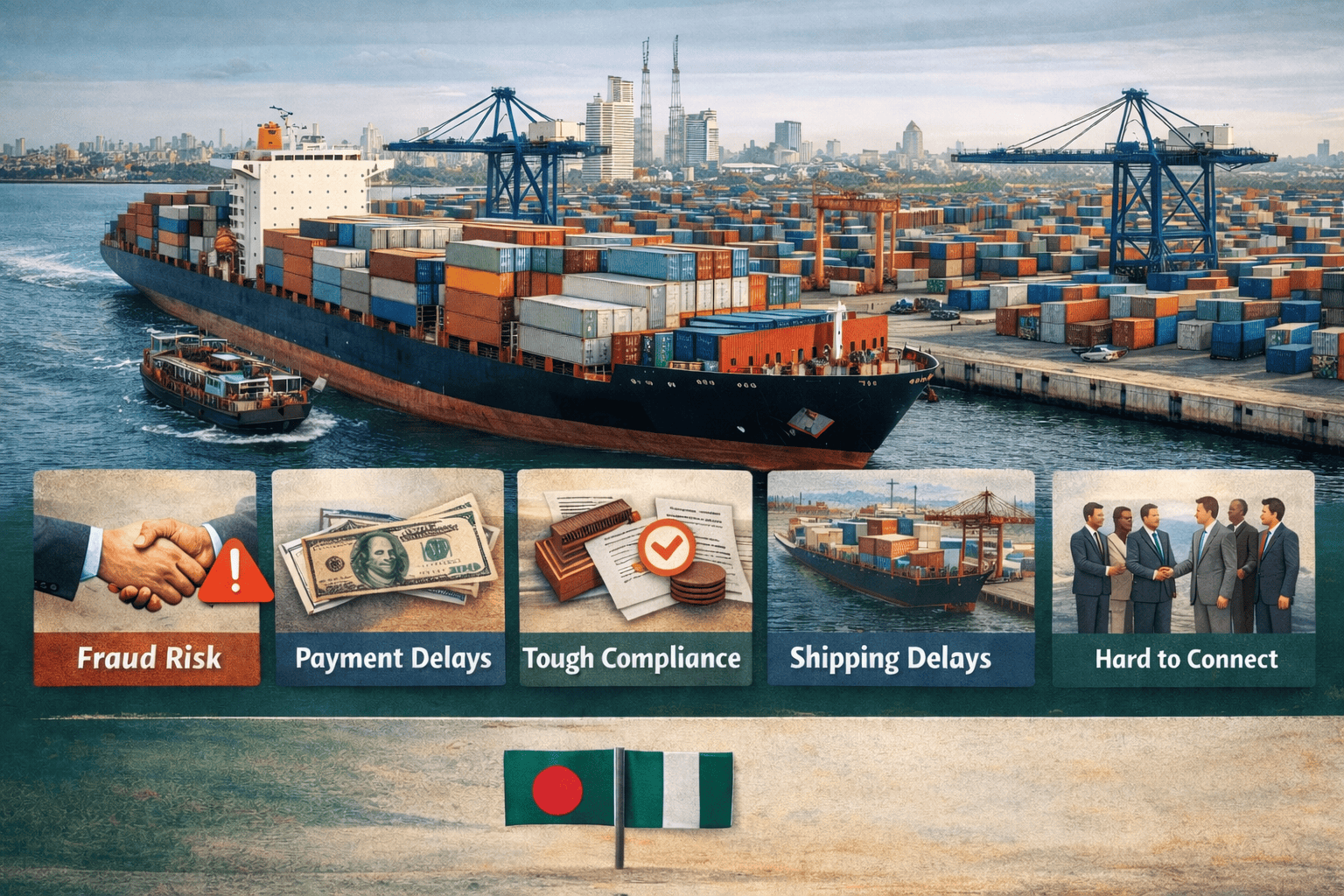
Challenges Bangladeshi Exporters Face When Entering the Nigeria Market
Nigeria is one of Africa’s largest and most dynamic import-driven economies, offering significant opportunities for global exporters. With a population exceeding 220 million and total imports valued at over $50 billion annually, the country represents a high-potential market for Bangladeshi businesses seeking diversification beyond traditional regions like Europe and North America.
However, entering the Nigerian market is not without its challenges. Many Bangladeshi exporters face operational, financial, and regulatory barriers that can delay market entry or increase risk. Understanding these challenges is essential for building a sustainable and profitable export strategy.
In this guide, we explore the key Bangladesh to Nigeria export challenges and provide practical solutions to help exporters successfully navigate this complex but rewarding market.
Understanding the Nigeria Market Opportunity
Nigeria’s economy depends heavily on imports across multiple sectors, including machinery, pharmaceuticals, food products, textiles, and industrial equipment. According to World Bank and International Trade Centre, the country continues to experience strong import demand due to rapid urbanization, population growth, and limited domestic manufacturing capacity.
For Bangladeshi exporters, this creates strong opportunities in sectors such as ready-made garments, pharmaceuticals, jute-based products, leather goods, and processed foods. However, without proper preparation and market understanding, exporters may struggle to convert these opportunities into actual business success.
1. Buyer Trust and Verification Issues
One of the most critical challenges exporters face is verifying the credibility of Nigerian buyers. In many cases, businesses rely on online communication or intermediaries, which increases the risk of dealing with fraudulent or unreliable partners.
This lack of trust can result in non-payment, contract disputes, or even complete loss of goods. For new exporters, especially those without prior experience in African markets, this becomes a major barrier to entry.
To overcome this challenge, exporters must prioritize working with verified buyers and trusted networks. Platforms such as Africa Bangladesh Business Forum help facilitate direct connections between Bangladeshi exporters and genuine African buyers through structured B2B matchmaking and trade events.
Additionally, Kingmansa offers a secure environment where exporters can connect with verified buyers, reducing the risk of fraud and improving transaction reliability.
2. Payment and Currency Challenges
Payment-related issues are another major concern in Bangladesh to Nigeria trade. Nigeria has experienced foreign exchange shortages and currency volatility in recent years, particularly affecting the Nigerian Naira.
According to the World Bank, fluctuations in exchange rates and limited access to foreign currency can lead to delays in international payments and create uncertainty for exporters.
This often results in delayed payments, exchange rate losses, and cash flow disruptions. For small and medium-sized exporters, these financial risks can significantly impact business sustainability.
To mitigate these risks, exporters should adopt secure payment mechanisms such as escrow systems and structured payment platforms. Kingmansa addresses this issue by enabling secure cross-border transactions, including local currency payment solutions that reduce dependency on volatile exchange rates and improve payment efficiency.
3. Logistics and Port Congestion
Efficient logistics is essential for successful export operations, but Nigeria presents several logistical challenges. Major ports, particularly Lagos, frequently experience congestion, leading to delays in cargo handling and customs clearance.
The World Trade Organization highlights that logistics inefficiencies and infrastructure gaps remain key trade barriers in many developing economies, including Nigeria.
For exporters, this translates into longer delivery times, increased shipping costs, and reduced reliability. These factors can negatively affect customer satisfaction and overall competitiveness.
To address these challenges, exporters should work with logistics partners who have experience in African trade routes. Kingmansa provides integrated logistics support, including shipment coordination, freight solutions, and real-time tracking, helping businesses manage their supply chains more effectively.
4. Complex Import Regulations and Compliance
Nigeria has a structured but often complex import regulatory framework. One of the key requirements is SONCAP certification, which ensures that imported products meet the standards set by the Standards Organization of Nigeria.
According to the Nigeria Bureau of Statistics, regulatory compliance is mandatory for all imports, and failure to meet these requirements can result in shipment delays, penalties, or rejection at the port.
Exporters often face challenges related to documentation, certification, and changing regulatory policies. Without proper knowledge and preparation, these compliance issues can become costly and time-consuming.
To overcome this, exporters should seek guidance from experienced trade facilitators and local partners. ABBF plays an important role in supporting exporters with market insights, regulatory guidance, and access to reliable local networks, making the compliance process more manageable.
5. Market Information and Pricing Gaps
Another significant barrier is the lack of accurate and reliable market information. Many Bangladeshi exporters enter the Nigerian market without a clear understanding of consumer preferences, competitive pricing, and demand trends.
This can lead to incorrect pricing strategies, product mismatches, and low sales performance. Without proper market intelligence, even high-quality products may fail to gain traction.
To address this challenge, exporters must invest in market research and direct engagement with buyers. Trade platforms and business forums like ABBF provide valuable opportunities for exporters to interact with real buyers, gather feedback, and understand market dynamics firsthand.
Such exposure helps businesses refine their product offerings and pricing strategies, increasing their chances of success.
6. Lack of Direct Buyer Access
Many exporters rely heavily on intermediaries when entering new markets. While intermediaries can provide initial access, they often reduce profit margins and limit control over business transactions.
In Nigeria, the lack of direct buyer access can create communication gaps, delay decision-making, and increase dependency on third parties. This makes it difficult for exporters to build long-term, trust-based relationships.
To overcome this barrier, exporters should focus on building direct connections with buyers. Participating in trade shows, business summits, and B2B networking events is one of the most effective ways to achieve this.
ABBF organizes international trade events that bring together verified buyers and exporters, enabling face-to-face interactions and long-term business partnerships. These platforms help reduce reliance on intermediaries and improve overall business outcomes.
7. Tariffs and Trade Policy Uncertainty
Tariffs and trade policies can significantly impact export competitiveness. Nigeria imposes import duties on various product categories, and policy changes can occur depending on economic conditions.
The World Trade Organization notes that tariff structures in developing markets can be complex and subject to periodic adjustments.
For exporters, this creates uncertainty in pricing and cost calculations. Unexpected changes in duties or regulations can affect profitability and disrupt business planning.
To manage this risk, exporters should stay informed about policy updates and work with experienced partners who understand the regulatory landscape. Structured trade platforms and business networks can help exporters navigate these complexities more effectively.
How Bangladeshi Exporters Can Succeed in Nigeria
Despite these challenges, Nigeria remains a highly attractive market with long-term growth potential. Many Bangladeshi exporters are already achieving success by adopting structured and strategic approaches.
Key success strategies include:
- Conducting thorough market research before entry
- Working only with verified and trusted buyers
- Using secure and transparent payment systems
- Partnering with reliable logistics providers
- Building direct relationships through trade events
In this context, ecosystems like Africa Bangladesh Business Forum and Kingmansa play a critical role.
ABBF focuses on creating opportunities through trade shows, business summits, and B2B matchmaking, while Kingmansa supports execution through verified connections, secure payments, and end-to-end logistics solutions.
Conclusion
Nigeria offers immense opportunities for Bangladeshi exporters, but it is not a market to approach without preparation. Understanding the Bangladesh to Nigeria export challenges is essential for minimizing risks and maximizing success.
From buyer verification and payment issues to logistics and regulatory barriers, each challenge requires a strategic solution. By leveraging trusted platforms, building direct networks, and adopting structured trade practices, exporters can successfully enter and grow in the Nigerian market.
With the right approach and the support of organizations like ABBF and platforms like Kingmansa, Bangladeshi businesses can unlock new growth opportunities and establish a strong presence in one of Africa’s most promising markets.