

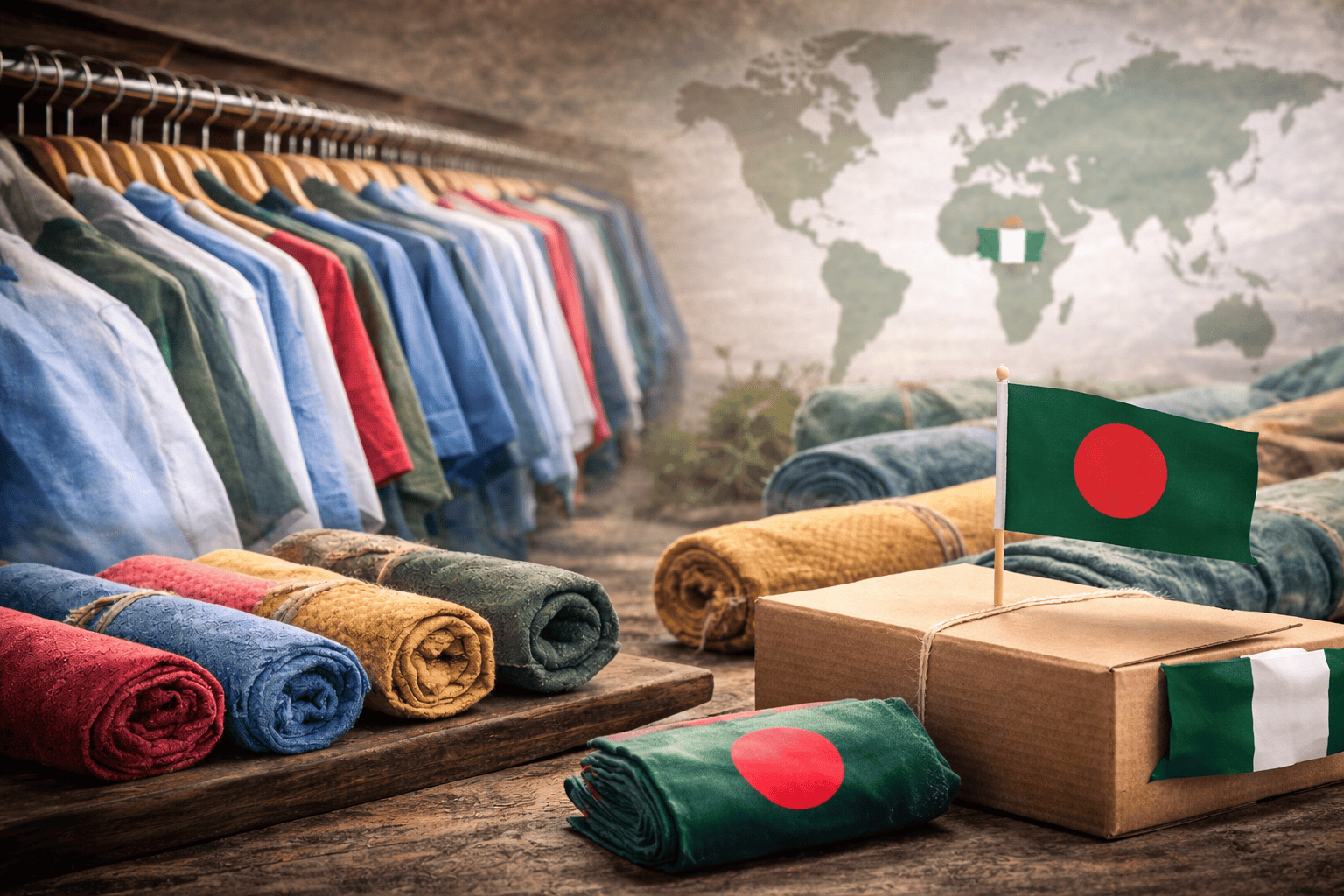
Bangladeshi Textile and Clothing in Nigeria: Import Data, Market Demand & Export Opportunity
Bangladeshi Textile and Clothing in Nigeria presents a significant export opportunity as Nigeria continues to rely heavily on imported garments and textile materials to meet domestic demand. For Bangladeshi exporters looking to diversify beyond traditional EU and US markets, Nigeria offers a high-growth, underpenetrated African destination.
Nigeria is Africa’s largest economy with a population exceeding 220 million (World Bank). Despite having a local textile history, production capacity remains limited compared to consumption demand. As a result, Nigeria imports large volumes of finished garments, fabrics, and textile inputs every year.
Market Overview of Bangladeshi Textile and Clothing in Nigeria
According to World Integrated Trade Solution (WITS), 2023 data, Nigeria’s textile and clothing import structure shows strong dependence on foreign suppliers.
Nigeria’s Textile & Clothing Imports by Major Suppliers (2023)
(Source: WITS – Values Converted from US$ Thousand to USD Million)
| Country | Import Value (USD Million) |
|---|---|
| China | $394.86 Million |
| Japan | $59.57 Million |
| India | $43.30 Million |
| United States | $21.41 Million |
| Kenya | $17.51 Million |
| Tanzania | $9.77 Million |
| South Korea | $7.31 Million |
| Turkey | $6.51 Million |
| Thailand | $5.22 Million |
| Lithuania | $5.09 Million |
| South Africa | $5.09 Million |
| United Kingdom | $4.56 Million |
| Bangladesh | $2.07 Million |
This data clearly shows that Nigeria imports hundreds of millions of dollars’ worth of textile and clothing products annually, yet Bangladesh’s share remains very small.
Strategic Insight:
While China exported nearly $395 million worth of textile and clothing products to Nigeria, Bangladesh exported only $2.07 million in 2023 (WITS).
This indicates strong untapped potential for Bangladeshi Textile and Clothing in Nigeria.
Competitive Strength of Bangladeshi Textile and Clothing in Nigeria
Bangladesh is the world’s second-largest exporter of ready-made garments, exporting approximately USD 47+ billion in apparel in FY 2022–23 (Export Promotion Bureau – EPB Bangladesh).
Key Strengths of Bangladesh’s Textile Sector:
- Cost-efficient large-scale production
- Advanced knitwear and woven manufacturing
- Compliance-certified factories
- Experience supplying EU & US markets
- Strong private label and OEM capability
Nigeria’s market is price-sensitive but quality-conscious. Bangladeshi exporters can compete effectively in:
- Knit T-shirts & polo shirts
- Woven shirts & trousers
- Women’s fashion garments
- School uniforms
- Industrial & corporate uniforms
- Fabric rolls for tailoring markets
Given the existing import structure, Bangladeshi Textile & Clothing in Nigeria can position itself as a reliable alternative to dominant Asian suppliers.
Import Trends & Growth Potential for Bangladeshi Textile and Clothing in Nigeria
Nigeria’s apparel imports (HS Chapters 61 & 62) and textile fabric imports (HS 52–60) together represent a multi-hundred-million-dollar annual market (WITS / UN COMTRADE 2023).
China dominates the market, followed by India and other Asian suppliers. However, Bangladesh’s export value remains comparatively low.
Growth Scenario Analysis:
If Bangladeshi exporters capture even:
- 1% of China’s current export value → ≈ $3.9 million
- 3% share → ≈ $11.8 million
- 5% share → ≈ $19+ million
This demonstrates the scalability of Bangladeshi Textile and Clothing in Nigeria if structured market engagement is implemented.
Sector-Specific Demand Opportunities in Nigeria
Retail & Wholesale Distribution
Nigeria has large garment wholesale hubs in Lagos, Abuja, and Kano. Affordable ready-made clothing sees consistent demand.
Institutional & Corporate Uniforms
Banks, schools, hospitals, hospitality groups, and security agencies require bulk uniform supply contracts.
Fabric & Tailoring Industry
Nigeria has a strong tailoring culture, driving demand for imported fabrics and textile rolls.
Each of these segments presents long-term opportunity for Bangladeshi Textile & Clothing in Nigeria.
How ABBF Supports Bangladeshi Textile and Clothing in Nigeria Market Entry
Entering Nigeria requires trusted connections, verified buyers, and local engagement.
The Africa Bangladesh Business Forum (ABBF) is actively building structured trade bridges between Bangladesh and African markets.
ABBF facilitates:
- Verified buyer–supplier networking
- Direct B2B matchmaking
- Trade show participation
- Government & private sector engagement
- Long-term Africa–Bangladesh trade partnerships
For textile and garment exporters, ABBF reduces entry barriers and creates real business opportunities in Nigeria.
Exhibit at Africa Bangladesh Trade Show & Business Summit – Nigeria 2026
If you are a textile mill, garment manufacturer, or apparel exporter, this is your strategic entry platform.
Africa Bangladesh Trade Show & Business Summit – Nigeria 2026
By exhibiting, you can:
- Meet verified Nigerian importers
- Explore wholesale and distribution partnerships
- Secure institutional garment contracts
- Expand into broader West African markets
Register as an Exhibitor and position your brand in Nigeria’s growing textile market.
Scale Beyond Nigeria with Kingmansa
In today’s trade environment, physical presence must be supported by digital visibility.
Kingmansa, the official B2B marketplace partner of ABBF, enables exporters to:
- Connect with verified global buyers
- Use secure local currency cross-border payment systems
- Reduce transaction risks through structured trade processes
- Receive and respond to verified RFQs
By joining Kingmansa, exporters of Bangladeshi Textile & Clothing in Nigeria can expand not only in Nigeria but across multiple African markets.
Join Kingmansa today and strengthen your global export footprint.
Final Strategic Conclusion
Nigeria’s textile and clothing import data confirms a large, active, and supplier-driven market. Demand is measurable. Import volume is substantial. Bangladesh’s current share remains small.
This creates a rare opportunity window.
For forward-thinking exporters, Bangladeshi Textile & Clothing in Nigeria represents:
- A high-growth African expansion market
- A low-competition positioning opportunity
- A scalable long-term export destination
Through structured engagement via ABBF’s Nigeria 2026 platform and digital expansion through Kingmansa, Bangladeshi textile exporters can transform opportunity into sustained trade growth.