

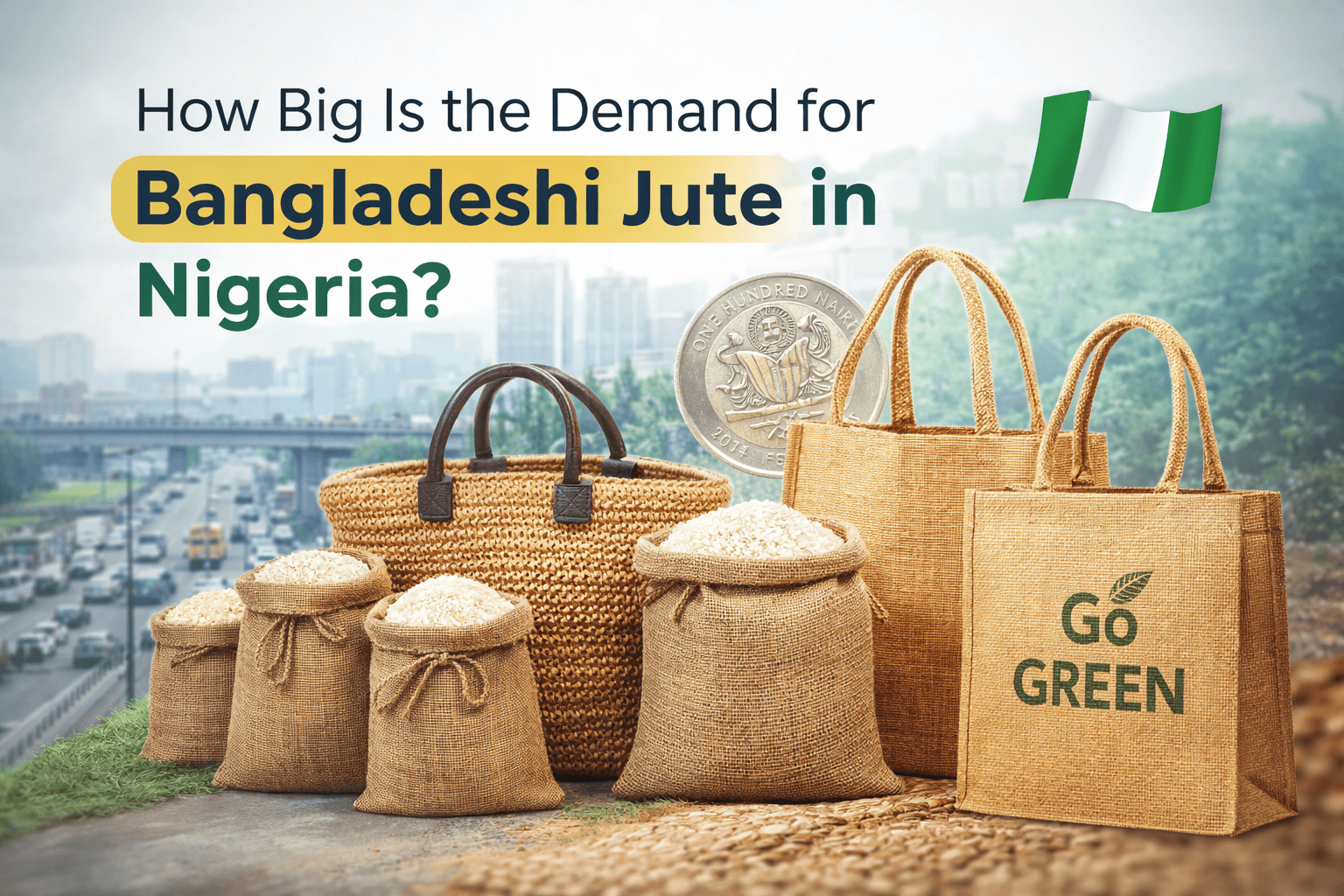
How Big Is the Demand for Bangladeshi Jute in Nigeria?
Bangladeshi Jute in Nigeria is emerging as a promising trade opportunity as the country’s economy expands, agricultural production grows, and demand for sustainable packaging increases. Nigeria, Africa’s largest economy by GDP and one of its most populous nations with over 220 million people (World Bank), relies heavily on imports for industrial raw materials, packaging products, and manufactured goods.
For Bangladesh, one of the world’s leading producers and exporters of jute, this presents a strategic opening in West Africa.
This article explores Nigeria’s market demand, trade insights, sector opportunities, and how exporters can position themselves effectively.
Nigeria Market Demand & Opportunity for Bangladeshi Jute in Nigeria
Nigeria’s Import-Driven Economy
Nigeria imports tens of billions of dollars’ worth of goods annually. According to World Bank and UN COMTRADE data, Nigeria’s merchandise imports typically range between USD 60–70 billion per year, covering machinery, textiles, industrial inputs, agricultural supplies, packaging materials, and consumer products.
Although Bangladesh’s exports to Nigeria are still developing compared to larger markets like the EU, there is steady import activity in:
- Textiles and industrial fabrics
- Packaging materials
- Consumer goods
- Agricultural storage products
This creates entry points for Bangladeshi Jute in Nigeria, especially in sectors where biodegradable and breathable materials are required.
Nigeria’s Agricultural Sector: A Major Driver
Nigeria’s agriculture sector contributes roughly 20–25% of GDP (World Bank estimates) and employs a large share of the population. Major agricultural outputs include:
- Cocoa
- Cashew
- Sesame
- Rice
- Cassava
- Grains
These commodities require strong, breathable sacks for storage and export. Traditionally, synthetic polypropylene bags dominate the market. However, global sustainability trends and environmental awareness are increasing demand for natural fiber packaging.
Jute sacks are:
- Biodegradable
- Durable
- Cost-effective
- Suitable for agricultural storage
This makes Bangladeshi Jute in Nigeria highly relevant for agricultural packaging and commodity export chains.
Rising Demand for Eco-Friendly Retail Packaging
Urbanization in Nigeria is accelerating. Lagos alone is one of Africa’s largest cities, and organized retail is expanding rapidly. With global pressure to reduce plastic usage, reusable shopping bags and sustainable packaging are gaining popularity.
Bangladeshi exporters can supply:
- Branded jute shopping bags
- Corporate promotional eco-bags
- Sustainable gift packaging
- Lifestyle jute accessories
As consumer awareness increases, retail-driven demand for jute products is expected to grow steadily.
Bangladesh: A Global Jute Export Leader
Bangladesh remains one of the world’s largest exporters of raw jute and diversified jute products. According to Bangladesh’s Export Promotion Bureau (EPB):
- Bangladesh exports hundreds of millions of dollars’ worth of jute and jute goods annually.
- Key export items include jute yarn, twine, sacks, hessian cloth, carpets, and diversified jute products.
- The European Union is a major destination, but market diversification is a national priority.
Expanding Bangladeshi Jute in Nigeria aligns with Bangladesh’s broader export diversification strategy into emerging markets.
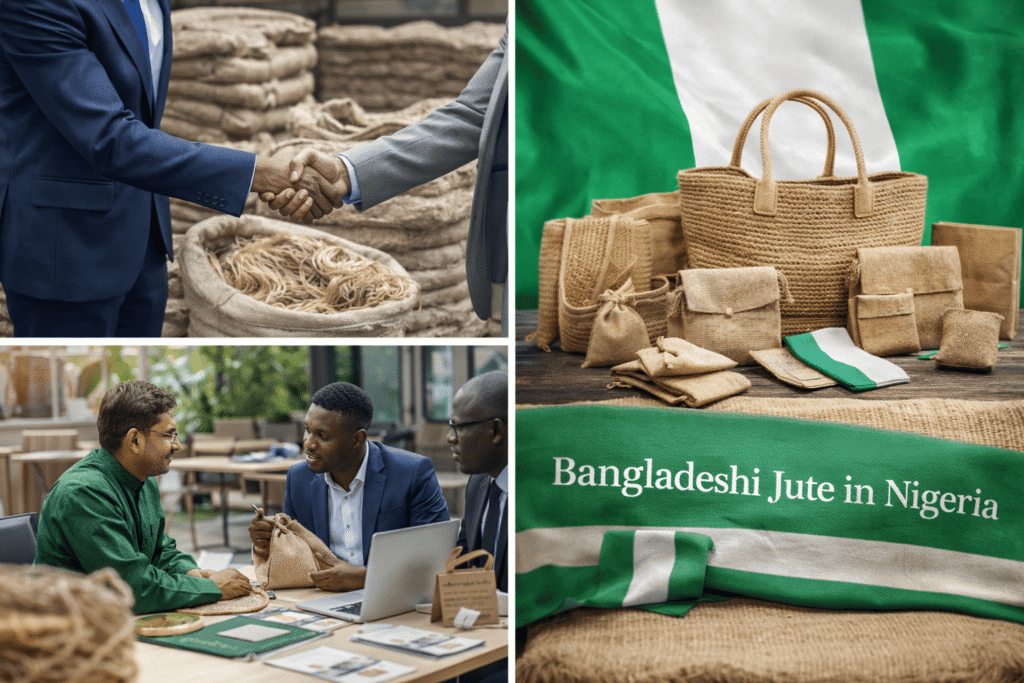
Trade Insights & Growth Potential for Bangladeshi Jute in Nigeria
Current Trade Context
UN COMTRADE data indicates that Nigeria imports jute-related products under relevant HS codes, though volumes remain smaller compared to Asian and European markets. This suggests:
- The market is not saturated.
- Competition is manageable.
- Awareness and structured trade engagement can significantly expand demand.
Bangladesh already exports other product categories to Nigeria, including textiles and light industrial goods. This existing trade relationship creates a foundation for scaling Bangladeshi Jute in Nigeria further.
Why Demand Is Likely to Increase
Several macro-level factors support long-term growth:
- Environmental Concerns – Nigeria faces plastic waste challenges, increasing interest in biodegradable alternatives.
2. Agricultural Export Standards – International commodity buyers often prefer natural packaging materials.
3. Urban Retail Growth – Expanding middle-class consumer markets drive reusable packaging demand.
4. Infrastructure Development – Jute geotextiles can be used for erosion control and soil stabilization in construction projects.
5. Competitive Production Cost – Bangladesh’s established jute ecosystem allows cost-effective production at scale.
These structural trends indicate strong future prospects for Bangladeshi Jute in Nigeria.
Leading Bangladeshi Jute Exporters
Bangladesh has several large and experienced jute exporters, including:
- Bangladesh Jute Mills Corporation (BJMC)
- Akij Jute Mills Ltd.
- Janata Jute Mills Ltd.
- Talukder Jute Mills Ltd.
- Alhaj Jute Mills Ltd.
- MASK Associates (Pvt) Ltd.
Notably, MASK Associates (Pvt) Ltd. has participated in past Africa–Bangladesh business events and is known for diversified jute exports.
These companies demonstrate Bangladesh’s production capacity and export reliability, strengthening confidence in expanding Bangladeshi Jute in Nigeria.
How to Connect & Expand Bangladeshi Jute in Nigeria
Demand potential alone is not enough. Market access requires structured networking, verified buyers, and secure trade mechanisms.
Participate in Structured Trade Platforms
The Africa Bangladesh Business Forum (ABBF) actively builds Africa–Bangladesh trade connections through networking programs, business forums, and B2B matchmaking initiatives.
One major upcoming platform is:
Africa Bangladesh Trade Show & Business Summit – Nigeria 2026
15–16 June 2026
Lagos, Nigeria
For exporters targeting Bangladeshi Jute in Nigeria, this summit offers:
- Direct access to verified Nigerian importers
- Structured B2B meetings
- Market insight sessions
- Distributor and retail connections
- Face-to-face negotiation opportunities
Instead of relying solely on remote outreach, exporters can build real partnerships on the ground.
Secure Your Booth
Or Visit: www.africabangladesh.com
Use Verified Digital B2B Channels
In addition to physical networking, digital trade platforms reduce risk and expand reach.
Kingmansa, ABBF’s official marketplace partner, is a global B2B marketplace connecting verified suppliers and buyers worldwide.
Kingmansa supports cross-border trade through:
- Verified supplier profiles
- RFQ (Request for Quotation) system
- Live buyer–supplier chat
- Secure local currency payments
- End-to-end logistics coordination
For exporters of Bangladeshi Jute in Nigeria, this means:
- Reduced payment friction
- Transparent pricing
- Faster negotiation
- Simplified documentation
- Improved trust
Build Long-Term Distribution Strategy
To scale Bangladeshi Jute in Nigeria, exporters should focus on:
- Partnering with local importers
- Appointing regional distributors
- Supplying agro-export firms
- Targeting retail chains
- Working with branding agencies
Nigeria’s key commercial hubs Lagos, Abuja, Port Harcourt, and Kano, offer diversified regional opportunities.
Long-term contracts and stable supply chains will determine sustainable growth.
How Big Is the Demand?
The demand for Bangladeshi Jute in Nigeria is not yet fully developed, which makes it a high-potential growth market rather than a saturated one.
Nigeria’s:
- Large population
- Agricultural scale
- Import dependence
- Retail expansion
- Sustainability awareness
— all create favorable conditions for jute products.
Bangladesh has the production strength.
Nigeria has a market need.
Through structured networking via ABBF, participation in the Nigeria 2026 summit, and verified digital trade through Kingmansa, exporters can convert opportunity into measurable expansion.
Africa’s largest economy is evolving — and sustainable trade is part of that evolution.
Now is the time to position Bangladeshi jute for long-term success in Nigeria.