

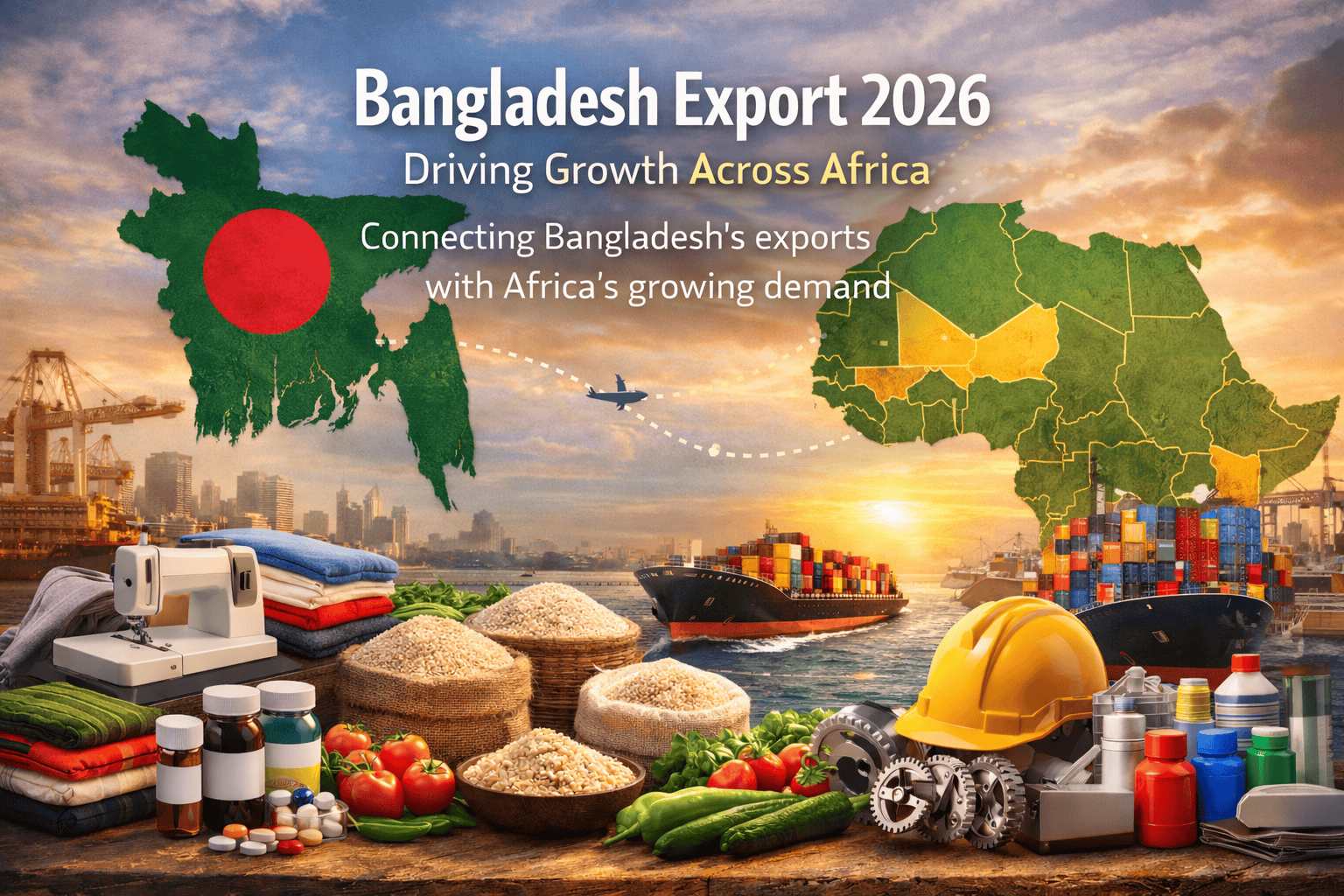
Why Bangladesh Export Matters Now More Than Ever
Bangladesh is entering a defining phase in global trade. As traditional markets mature and new regions open up, bangladesh export is evolving beyond garments into diversified, value-driven sectors.
This article is written for Bangladeshi exporters, SMEs, investors, and decision-makers who want a clear, practical understanding of where Bangladesh exports stand today, which markets matter most, and how Africa is shaping the next wave of growth.
By the end, you’ll gain actionable insights into products, markets, challenges, and realistic opportunities for 2026—grounded in regional trade realities, not theory.
Understanding Bangladesh Export in the Regional Context
At its core, bangladesh export refers to goods and services produced in Bangladesh and sold to international markets. While Europe and North America remain important, Africa is increasingly relevant due to population growth, infrastructure development, and rising consumer demand.
Key trends shaping this shift include:
- Growing demand for affordable, quality products
- Expanding intra-South cooperation
- Strong interest in bangladesh export products such as textiles, agro-products, light engineering goods, and pharmaceuticals
- Rising searches for bangladesh export country list and bangladesh export products list, reflecting exporter intent to diversify markets
For Bangladesh, Africa represents both a demand market and a strategic long-term partner—especially when trade is supported by structured platforms that connect businesses, institutions, and markets across both regions.
Key Challenges Between Bangladesh and Africa
Cross-border trade brings opportunity—but also friction. Common challenges include:
- Limited on-ground market intelligence
- Logistics complexity and longer transit times
- Trust gaps between buyers and suppliers
- Payment security and currency risks
- Compliance with varying import regulations
These challenges often explain why many promising export deals stall despite strong product demand, particularly when exporters operate without regional support, verification, or execution partners.
Practical Solutions & Best Practices
Experienced exporters follow structured approaches to reduce risk and increase success:
- Conduct product-market fit analysis before entry
- Work with verified buyers and suppliers only
- Use trade-secure payment mechanisms
- Plan logistics early, including port and warehousing strategy
- Leverage regional trade platforms and institutional support
In Bangladesh–Africa trade, platforms like Africa Bangladesh Business Forum play a facilitation role by connecting exporters with African buyers, chambers, embassies, and trade bodies.
Execution becomes more efficient when combined with marketplace solutions like Kingmansa, which enables verified sourcing, logistics coordination, and local currency payment options—helping bangladesh export products grow into sustainable, repeat trade relationships.
Industry Expertise & Regional Experience
Successful Bangladesh–Africa trade is built on experience, not assumptions. The Africa Bangladesh Business Forum works closely with government agencies, embassies, chambers of commerce, and private-sector stakeholders to promote structured and ethical trade across 50+ African countries and Bangladesh.
Through its ecosystem approach—and with Kingmansa as its marketplace partner—ABBF helps reduce information gaps, improve trust, and align market access with real execution. These elements are critical EEAT signals in cross-border commerce.
Key Sectors & Opportunities in Bangladesh–Africa Trade
Several sectors show strong alignment between Bangladesh’s capabilities and Africa’s demand:
Manufacturing
Light engineering, plastics, and consumer goods benefit from cost efficiency and scalable production.
Textile & RMG
Beyond apparel, home textiles, workwear, and uniforms are gaining traction across African markets.
Agriculture & Agro-Processing
Rice, processed foods, and agro-inputs meet growing urban demand.
Pharmaceuticals
Affordable, quality-assured medicines from Bangladesh are increasingly competitive.
Technology & Construction
ICT services, prefabricated materials, and construction inputs support Africa’s infrastructure growth.
These sectors consistently appear in bangladesh export products list queries tied to Africa.

What are the main Bangladesh export products for Africa?
The most in-demand bangladesh export products for Africa include garments, home textiles, pharmaceuticals, agro-processed foods, plastics, and light engineering goods. These products align with Africa’s price-sensitive but fast-growing consumer and infrastructure markets, making Bangladesh a competitive sourcing destination.
Which countries are on the Bangladesh export country list for Africa?
Common destinations on the bangladesh export country list include Nigeria, Kenya, Ethiopia, Ghana, Tanzania, and South Africa. These countries have strong import demand, expanding middle classes, and established trade routes with South Asian suppliers.
How can Bangladeshi exporters reduce risk in African markets?
Risk is reduced through buyer verification, structured contracts, secure payment terms, and logistics planning. Working with regional trade facilitation platforms like Africa Bangladesh Business Forum and verified marketplaces such as Kingmansa helps exporters avoid fraud, reduce delays, ensure compliance, and execute cross-border trade with greater confidence.
Is logistics a major barrier for Bangladesh export to Africa?
Logistics can be complex due to distance and port variations, but it is manageable. Early planning, coordinated logistics support through platforms like Kingmansa, and proper documentation significantly improve delivery timelines, visibility, and cost control in Bangladesh–Africa trade.
How do payments usually work in Bangladesh–Africa trade?
Payments typically use LC, advance TT, or escrow-supported structures. Increasingly, exporters prefer platforms like Kingmansa that enable local currency payments, reducing FX risk, improving settlement transparency, and strengthening payment security for bangladesh export growth.
Can SMEs participate in Bangladesh export to Africa?
Yes. SMEs can enter Africa successfully by focusing on niche products, starting with smaller volumes, and using structured B2B matchmaking instead of open-market exposure.
Realistic Bangladesh–Africa Use Case
A mid-sized Bangladeshi home-textile manufacturer sought new markets beyond Europe. Africa offered demand but lacked visibility. Through structured matchmaking, verified buyers, coordinated logistics, and phased payments, the company stabilized exports within a year into recurring orders across multiple African markets.
Final Thoughts
The future of bangladesh export lies in diversification, trust, and regional partnerships. Africa is not an alternative market—it is a strategic growth frontier for 2026 and beyond.
Exporters who combine product readiness with market understanding, institutional support, and reliable trade execution will lead the next chapter of Bangladesh–Africa commerce.
If you’re exploring cross-border opportunities, now is the time to deepen your understanding, build the right connections, and approach Africa with a long-term trade mindset—not short-term transactions.